September 5, 2026
Pet Carrier Types: Choose for 5 Travel Scenarios
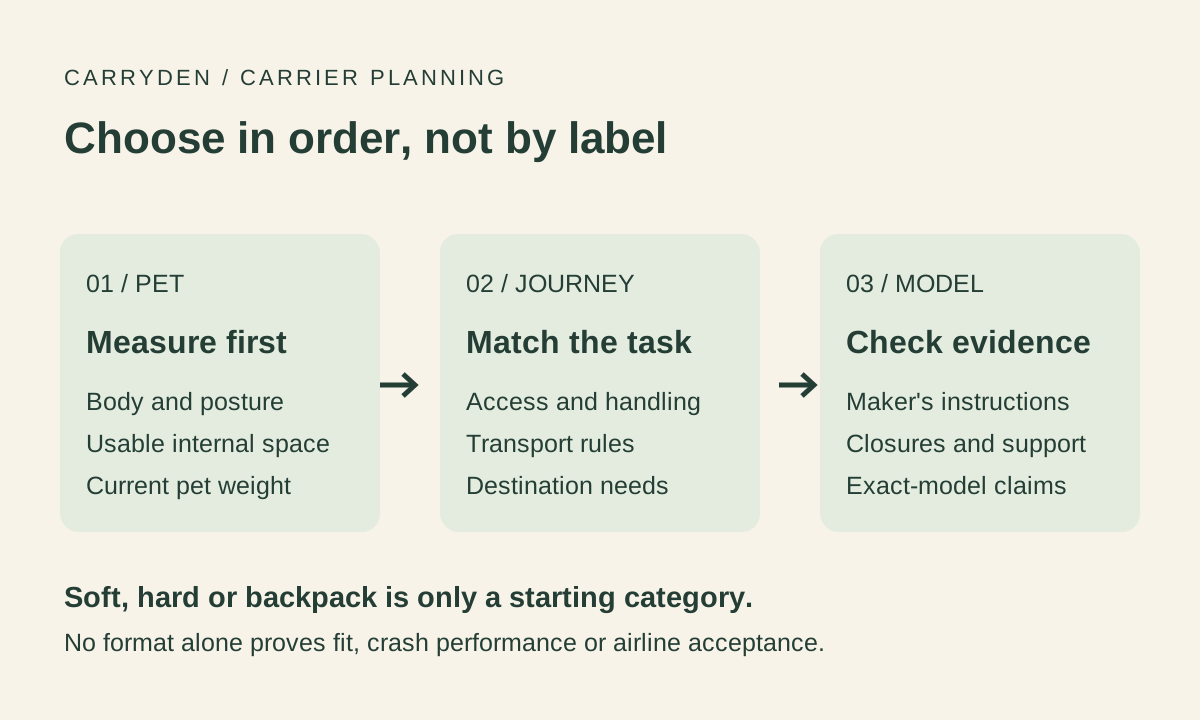
There is no universal best pet-carrier type. Start with your pet’s measured body, the posture required for the trip, and the rules of the transport provider. Then compare usable internal space, base support, openings, ventilation, closures, cleaning method and the combined carrying load.
Use the pet carrier measurement worksheet first. A format comparison cannot rescue the wrong size.
Planning to fly? Continue with the flight-specific airline pet carrier checklist before booking.
For planned familiarisation after choosing suitable equipment, follow the cat carrier training guide for door-related fear.
If a fire or other immediate danger is happening, this is not a training checklist. Follow local emergency instructions and get to safety. Do not delay escape to finish packing or practising. The Texas State Fire Marshal’s pet-fire guidance says not to go back into a fire for pets; tell firefighters if an animal is trapped.
What changes between pet carrier types?
| Format | Inspect before choosing | Questions it does not answer by itself |
|---|---|---|
| Soft-sided carrier | Internal frame, base support, mesh placement, zipper closures, top and side openings, cleaning instructions | Airline acceptance, usable internal space after compression, escape resistance or crash performance |
| Hard-sided carrier | Door and latch, removable top, ventilation, internal edges, base, handle and cleaning access | Whether the exact model fits the pet, aircraft or vehicle; whether it has been independently crash tested |
| Backpack or wearable carrier | Intended posture, base, height, shoulder and waist support, openings, ventilation, empty weight | Whether your pet can reposition as needed or whether the format is suitable for a long or regulated journey |
Material alone is not a safety result. A rigid shell is not proof of crash performance, and a soft label is not proof of airline acceptance. Only repeat a test or certification claim when it names the exact product, protocol and current evidence.
Choose for four routine travel scenarios
Veterinary visit
The Feline Veterinary Medical Association advises cat caregivers to look for a sturdy, easy-to-clean carrier and highlights removable tops or large openings that can let a cat remain in the base during an examination. If you use a soft carrier, inspect whether the opening keeps its shape and whether the clinic can reach the pet without pulling through a narrow door. Ask your own veterinary practice what setup helps them handle your pet.
Walking, errands and public transport
Empty carrier weight, strap adjustment, balance and the path from home to destination become important. Add the pet’s weight and anything packed inside before deciding what you can carry. A close-carry sling, structured backpack and hand-carried crate support different postures; check the product’s intended use rather than treating them as interchangeable.
Car travel
Do not turn a material preference into a crash-safety claim. The Feline Veterinary Medical Association’s 2025 position statement distinguishes carriers with crash-test certification from carriers without it. Follow the vehicle, restraint and carrier instructions that apply to the exact equipment. CarryDen does not claim independent crash certification for the examples below.
Air travel
IATA states that airlines and countries can impose their own requirements. Its 2026 Container Requirement 1 also says IATA does not certify or endorse commercial pet-container brands or models. Check the current operator policy for every flight, aircraft and connection, and confirm whether the published measurements are internal or external. A product name such as “travel” or “airline” is not approval.
Prepare for the fifth scenario: emergency evacuation
Plan the animal, carrier, helper and destination together before an emergency. Buying a different carrier does not finish that plan. The American Red Cross recommends including pets in the household evacuation plan, keeping their kit accessible and identifying places that can accommodate them. Call potential accommodation ahead; pet arrangements can differ by location and incident. Do not assume a shelter will house your animal beside you.
Before any warning: make a household handoff record
Our planning worksheet below turns those preparations into named responsibilities. It is an editorial organisation tool, not a rescue protocol or a tested evacuation-time estimate. Fill it in for each pet and review it with the people who may help you. Keep a copy with the supplies so another caregiver can use it.
| Record | Write down before it is needed | Resolve an empty field by |
|---|---|---|
| Pet and equipment | Pet name, carrier location, current fit check and closure instructions | Checking the physical carrier and its maker’s instructions |
| Person and backup | Who handles each pet; who can help if that person is away | Agreeing responsibilities with an available helper, without asking anyone to enter danger |
| Destination and transport | Primary and backup contact, pet acceptance, route and transport arrangement | Calling the destination and checking local emergency planning advice |
| Care and identification | Veterinary contact, care instructions, identification and document location | Reviewing the pet’s needs with the veterinarian and caregiver |
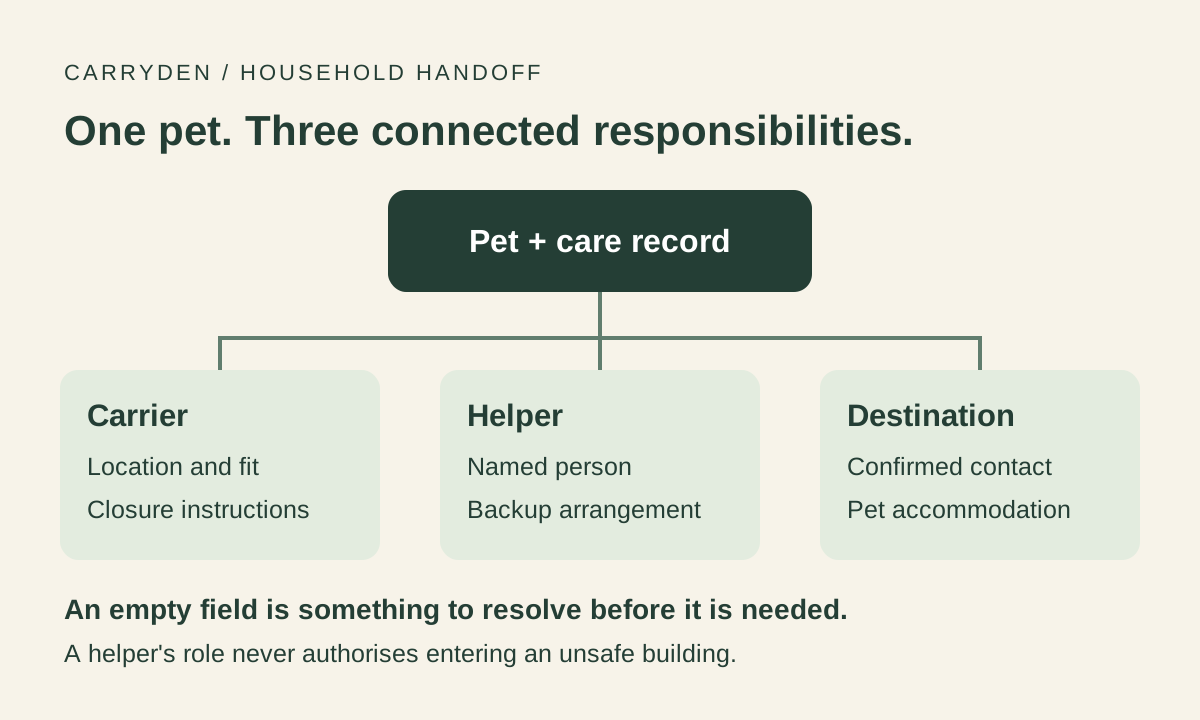
Illustrative household example: two cats and two adults do not automatically make a workable plan. If both carriers are in a locked store room and both adults assume the other is bringing the document pouch, the gap is access and responsibility. Resolve that during ordinary preparation. If one adult may be away, check whether the remaining person can manage the planned equipment and supplies, and arrange help in advance. This is a hypothetical planning example, not a report of a successful rescue.
Pack care supplies as well as transport equipment
The CDC pet disaster-kit checklist includes veterinary and identification records, photos, food, water, medication instructions, dishes, cleaning supplies and an appropriately sized carrier with bedding. Its list specifies a two-week supply of food, water and applicable medications. Ask your veterinarian how to plan prescriptions, storage and your animal’s individual needs; do not start or change medicines from this guide.
- Transport: check the carrier, closures, carrying points and suitable identification equipment.
- Care: organise the pet’s supplies, feeding instructions and needed cleaning or litter equipment.
- Records: keep readable copies and contact details protected from water.
The full preparedness supply and the load one person can carry are different questions. Work out transport for both beforehand; do not fill the pet’s usable carrier space with your supply kit. A long stay at the destination may require housing and care arrangements beyond the carrier used to get there.
Separate practice, evacuation and arrival
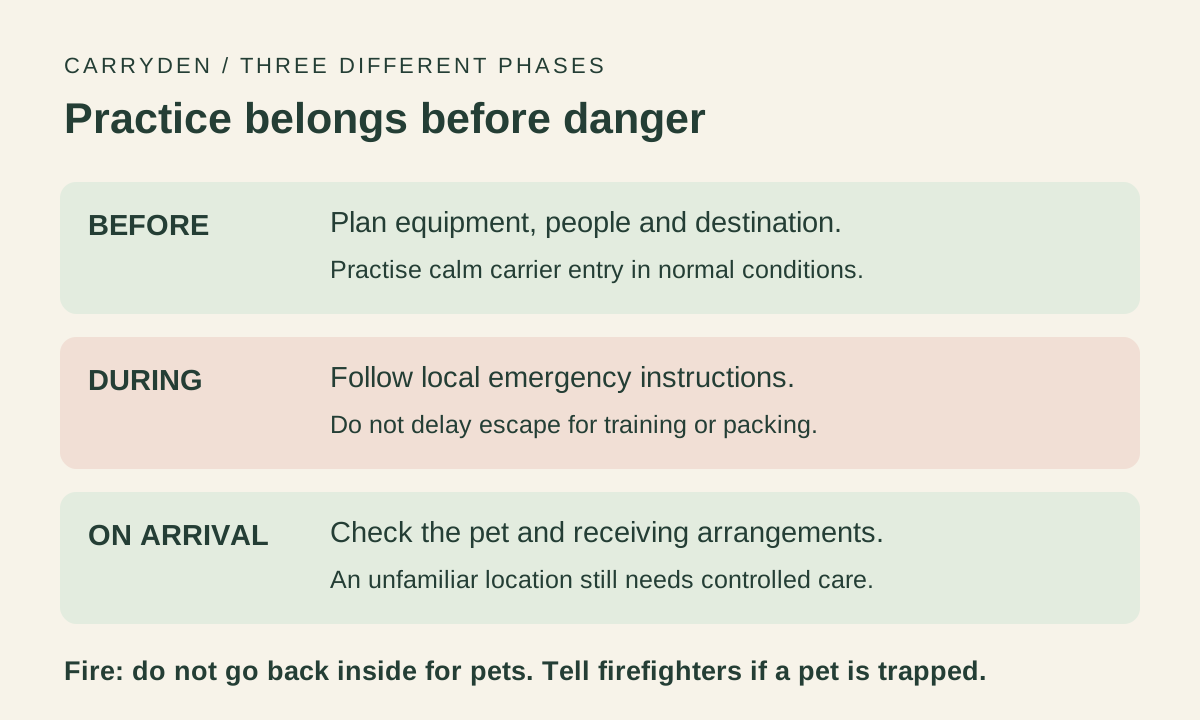
Practise calm carrier entry during normal conditions, using the gradual carrier familiarisation guide. If ordinary practice causes panic, seek veterinary or qualified behaviour guidance beforehand. A successful practice session does not prove that the same cue will work amid smoke, noise or disruption.
During an evacuation, follow the instructions for the actual hazard. The U.S. Fire Administration’s wildfire guidance stresses leaving promptly when told to evacuate and not waiting for an order if conditions feel unsafe. That is wildfire guidance, not a substitute for local instructions for floods, chemical incidents or other hazards.
At the receiving location, check the pet’s condition and follow its containment and care arrangements. The Red Cross warns that behaviour can change after a disaster and that damaged fences, debris or chemicals can create new hazards. Do not treat arrival as a reason to allow unfamiliar, uncontrolled roaming. Seek veterinary help for illness or injury; this article does not diagnose or treat either.
Compare published CarryDen wearable examples
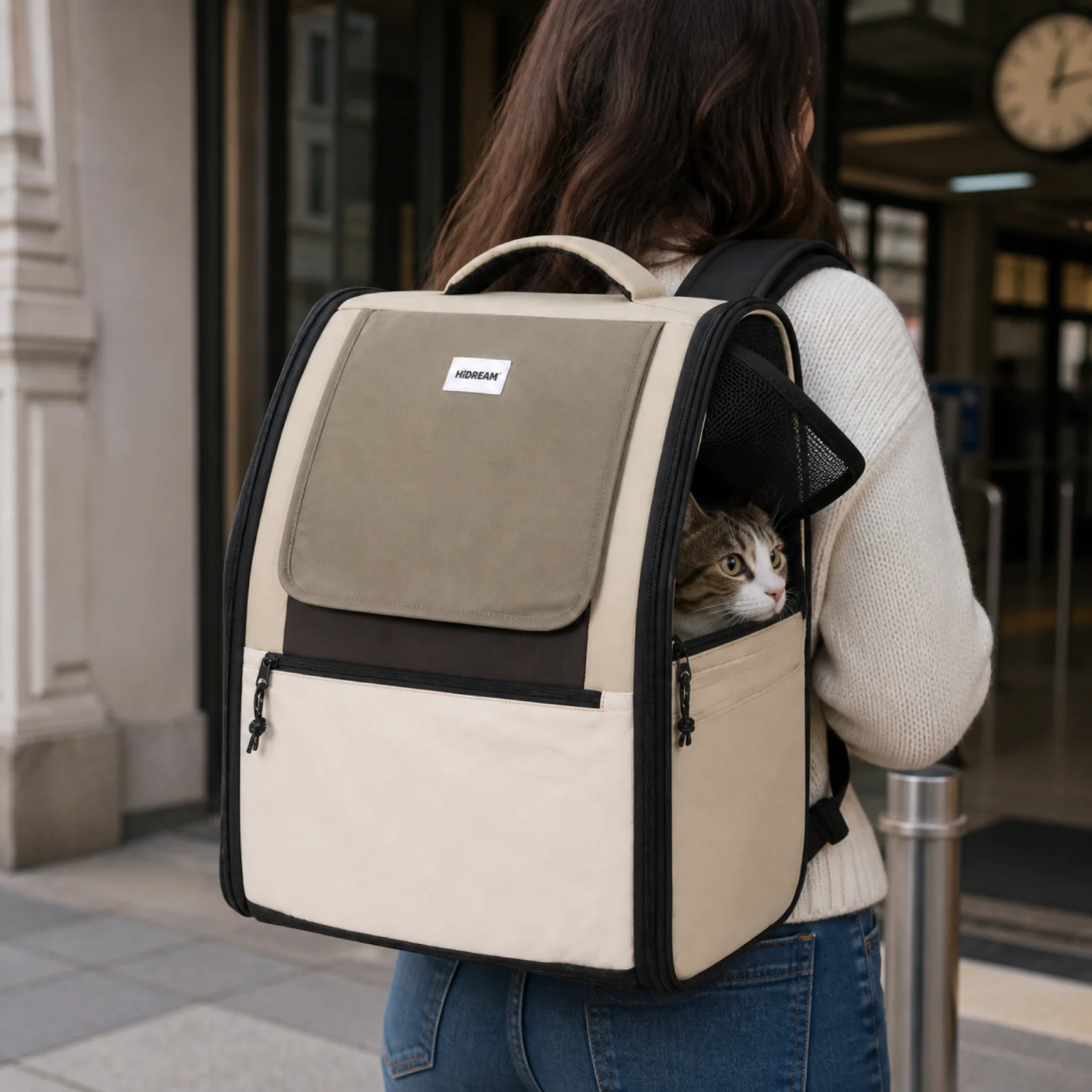
The CarryDen examples below are nylon wearable carriers, not hard-sided crates. Values were checked against the published product records on 5 September 2026; they are listing data, not independent sample measurements, fit approval or emergency-equipment certification. The catalogue image at the top is not a crash test or an evacuation demonstration.
| Product | Published dimensions | Empty weight | Suggested pet weight |
|---|---|---|---|
| Lightweight Pet Backpack | 36 × 23 × 43 cm | 555 g | Up to 7 kg |
| First Class Pet Backpack | 36.5 × 28 × 43 cm | 1.25 kg | Up to 8 kg |
| Mountain Pet Crossbody Carrier | 45 × 15 × 27 cm | Not stated | Up to 6 kg |
The same pet-weight ceiling cannot answer whether a person can handle the loaded carrier. For example, using an illustrative 5 kg pet, the listed 1.25 kg First Class backpack gives a combined 6.25 kg before bedding or supplies. This arithmetic is not a comfort test, a load rating or proof that the pet fits. The crossbody’s unlisted empty weight remains unknown rather than being estimated from its appearance.
A six-point inspection before purchase
- Fit: record body length, seated or standing height, width and current weight.
- Usable space: separate internal dimensions from external dimensions.
- Posture: decide whether the trip requires sitting, standing, turning, lying down or supported close carrying.
- Access: check every door, top opening, closure and how a nervous or injured pet could be reached.
- Handling: add pet, carrier and packed-item weight; inspect the base, handles and straps.
- Rules and evidence: verify current provider rules and any product-specific test documents.
Quick answers
Is a hard carrier always safer than a soft carrier?
No universal material-only conclusion is supportable. Match the exact carrier to the pet and trip, and require product-specific evidence for crash or transport claims.
Is a backpack appropriate for every cat or small dog?
No. Check the intended posture, usable internal space, base stability, ventilation, journey length and your pet’s behaviour. Some veterinary and welfare sources prefer larger hand-carried formats for cats.
Which carrier is accepted by airlines?
Only the airline can confirm acceptance for the specific journey. Recheck before departure because policies, aircraft and routes can change.
Can my everyday carrier also be my evacuation carrier?
Possibly, but the label “everyday” is not enough. Check the pet’s fit, the equipment’s condition, who can handle it and where the pet will go. Confirm the destination’s arrangements and plan supplies separately. CarryDen has not tested the listed models as an emergency evacuation system.
What if my cat will not enter the carrier during a fire?
Do not turn an active fire into a training session or delay your escape. Follow emergency instructions, get to safety and tell firefighters about a trapped pet. Do not go back inside to retrieve the animal or equipment.
Sources and evidence limits
CarryDen sells carriers and has a commercial interest in product links. This editorial comparison is not a physical product test, veterinary review or emergency-services endorsement. U.S. preparedness sources below provide planning guidance; readers elsewhere must check their local emergency authorities and receiving facilities. Sources were checked on 5 September 2026. Requirements and local arrangements can change.
- Feline Veterinary Medical Association / Cat Friendly Homes: choosing a carrier
- FelineVMA: 2025 transportation of cats in motor vehicles position statement
- IATA: Traveler’s Pet Corner
- American Red Cross: pet disaster preparedness
- CDC: pet disaster preparedness kit
- Texas State Fire Marshal: pet fire safety
- U.S. Fire Administration: wildfire evacuation guidance