September 5, 2026
Airline Pet Carrier Checklist: Verify Before You Fly
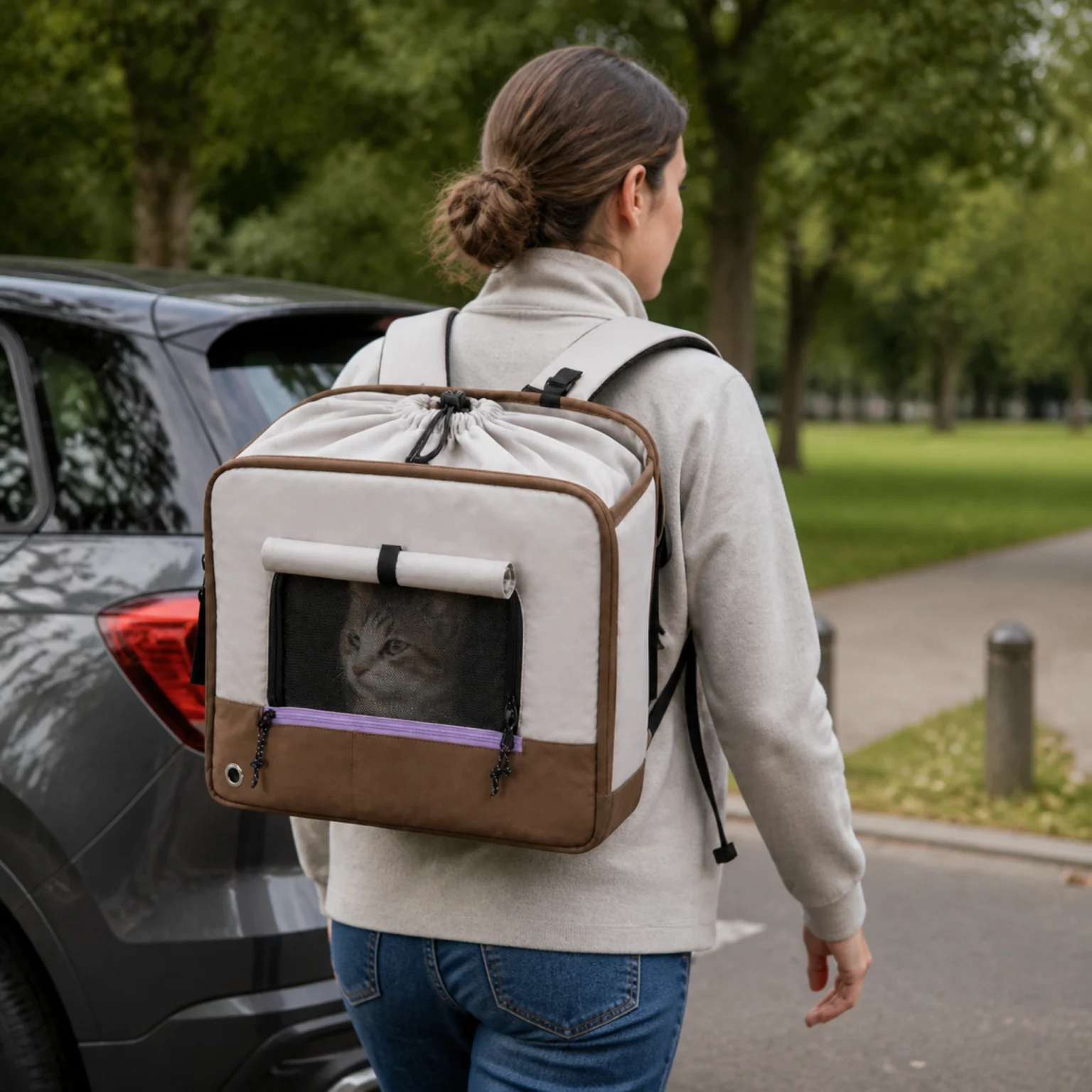
No pet carrier is approved for every airline, aircraft or journey. Before booking, compare your pet and the carrier with the operating airline’s current in-cabin rules for every flight segment. Record who confirmed the rules, when you checked, the aircraft if known, the maximum external carrier dimensions, the combined weight rule, pet eligibility, documents, fees and reservation status.
This checklist is for planning an in-cabin trip with a dog or cat. It does not replace the airline, government, veterinary or destination requirements that apply to your journey. Start with the pet carrier measurement worksheet, then use the carrier format comparison to inspect structure, openings and carrying load.
What “airline approved” does and does not mean
IATA publishes live-animal guidance, but it states that individual carriers may impose additional or more stringent policies. IATA also says it does not certify, approve, endorse or sell particular commercial pet containers. A marketplace badge, product title or seller statement therefore cannot replace confirmation from the airline operating your exact flight.
Airline policy pages can also distinguish soft-sided and hard-sided carriers, publish external rather than internal limits, change allowances by aircraft, limit the number of pets in the cabin, and require an advance pet reservation. Codeshare journeys add another question: the airline that sold the ticket may not be the airline operating the aircraft.
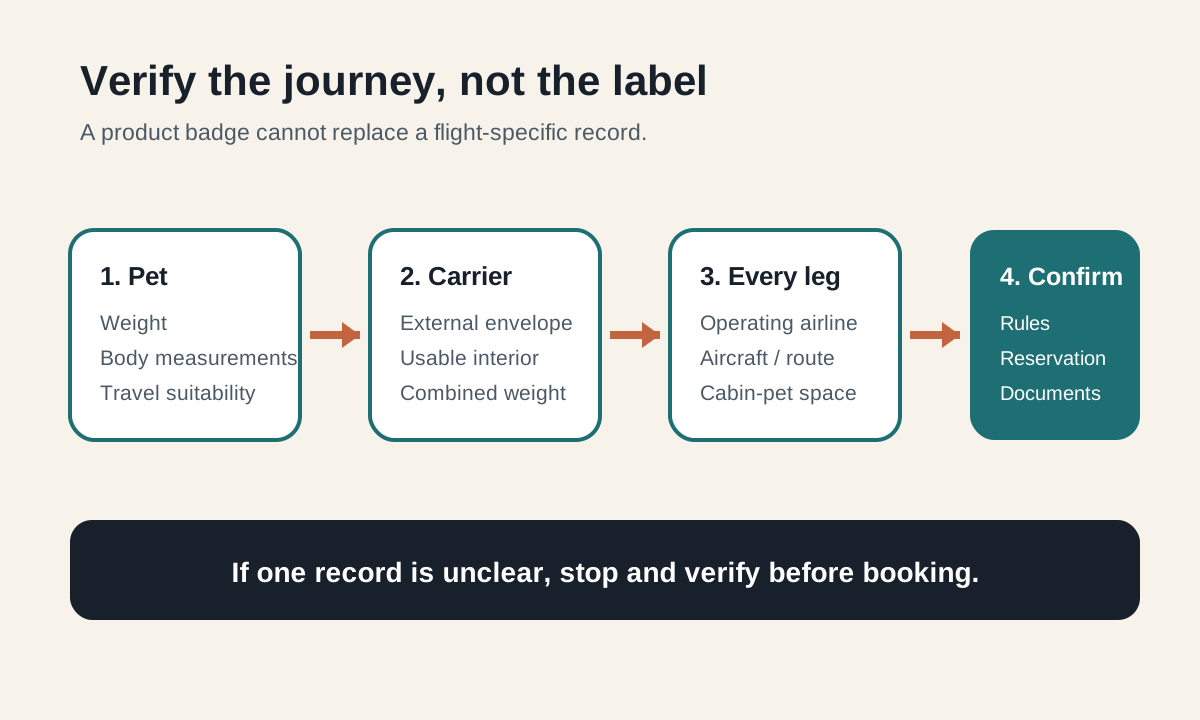
Build a flight-specific rule record
Create one row for each outbound and return segment. Do not copy a generic comparison table without checking the primary airline source on the date you plan to book.
| Field | What to record | Why it matters |
|---|---|---|
| Operating airline and flight | Airline, flight number, date, route and aircraft when available | A codeshare seller and the operating carrier can have different roles and rules. |
| Cabin-pet eligibility | Species, breed, age, route and destination restrictions | A carrier that fits does not make the pet or route eligible. |
| External carrier limit | Length × width × height, carrier type and aircraft exceptions | The physical bag must fit the airline’s stated stowage space. |
| Weight rule | Whether a limit applies to the pet, the carrier or their combined weight | Product “suggested pet weight” is not an airline allowance. |
| Reservation and fee | Confirmation number, cabin-pet capacity and payment timing | Many flights limit the number of animals accepted in the cabin. |
| Documents | Health, vaccination, identification, import, transit and destination records | Requirements depend on the route and can extend beyond the airline. |
| Last verified | Date, official URL and agent reference when contacted | A dated record makes a later change visible. |
If any field is unclear, contact the operating airline before purchasing a non-refundable ticket. Ask the airline to clarify whether the published measurements are maximum external dimensions and whether the carrier must remain under the seat for the full flight.
Measure the pet and carrier separately
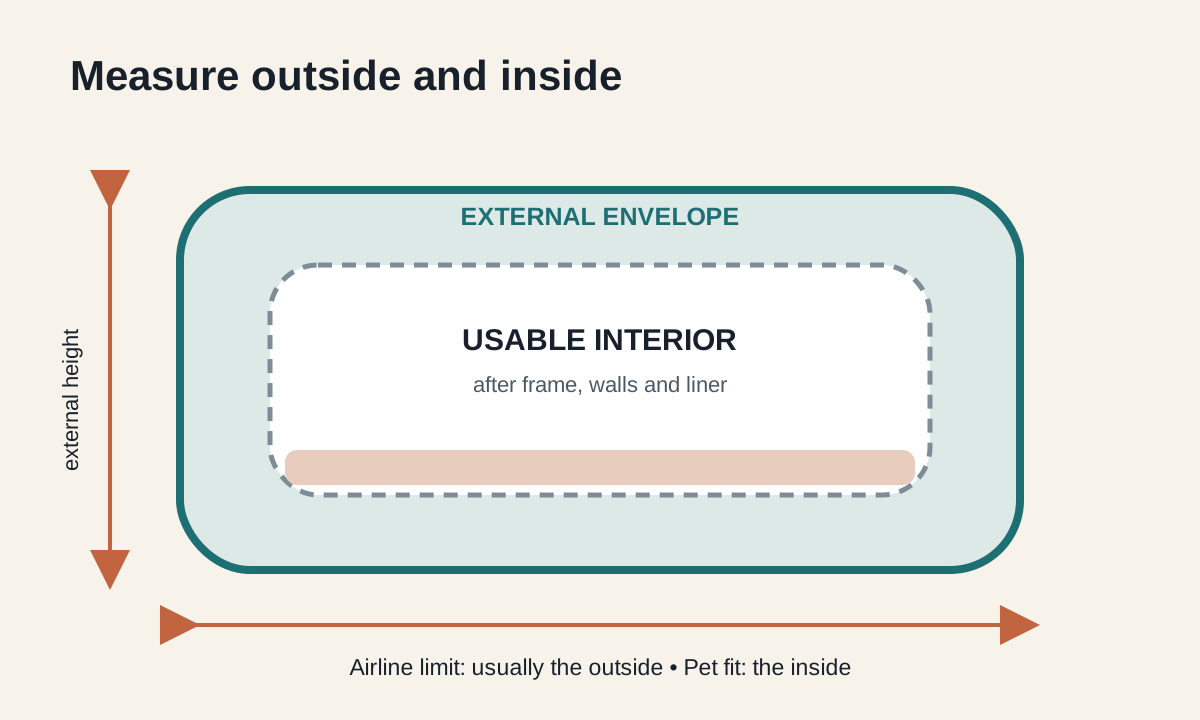
Measure the pet in the posture required by the airline and the carrier as a real object. Do not infer usable space from an exterior product label. For a soft-sided carrier, measure it standing naturally and note what happens to the roof, base and ventilation panels when it is placed under a representative seat-height limit. Do not compress it so far that the animal’s space or ventilation is compromised.
- Pet record: note current weight, body length, natural width and seated or standing height according to the relevant rule.
- Carrier exterior: measure the longest, widest and tallest external points with the base and frame in normal use.
- Carrier interior: check usable floor length, base width and headroom after the pad and liner are installed.
- Combined weight: weigh the pet, empty carrier, liner and anything that will remain inside.
- Movement: confirm the posture and ability required by the airline without forcing the pet into the carrier.
CarryDen’s Convertible Shoulder Pet Backpack is published as 43 × 19 × 42 cm, 742 g, nylon and suggested for pets up to 8 kg. Those are product facts, not airline acceptance. Its 42 cm height, wearable orientation and intended posture must be compared with the exact trip; CarryDen does not describe it as universally airline approved.
Inspect the physical carrier
Use the manufacturer’s instructions and the airline’s current requirements. Before each practice session and again before travel, inspect:
- all zippers, zipper joins, latches and door fasteners;
- mesh or ventilation panels for tears, blocked areas and distortion;
- the base for sagging, sharp edges, moisture and a shifting liner;
- handles, shoulder straps and attachment points under the combined load;
- internal clips or loose accessories that could snag a collar, limb or harness;
- labels and identification that remain readable without blocking airflow.
Do not improvise a medical sedative plan. IATA advises discussing the animal’s suitability for travel with a veterinarian and discourages sedation except under veterinary direction. The veterinarian, airline and destination authority may each address different parts of the journey.
Practise before travel day
The first closed-carrier session should not happen in the departure queue. Introduce the exact carrier at home with the door open. Let the pet approach voluntarily, pair calm investigation with familiar rewards, and progress in small steps: entering, resting, closing briefly, lifting, carrying, and spending time in a quiet stationary vehicle or other relevant setting when appropriate. For cats who enter but become frightened at closure, use the carrier door-training reset plan and contact the veterinary team early.
Keep sessions short enough that the pet can remain settled. If the animal is panting when not hot, drooling, repeatedly pawing at the exit, vocalising unusually, trying to escape, freezing or refusing future approaches, stop and reassess with a veterinarian or qualified behaviour professional. Acclimation is not a guarantee that air travel is suitable for every animal.
Recheck before departure
Policies and operating details can change after booking. Use a staged recheck rather than relying on a screenshot saved months earlier.
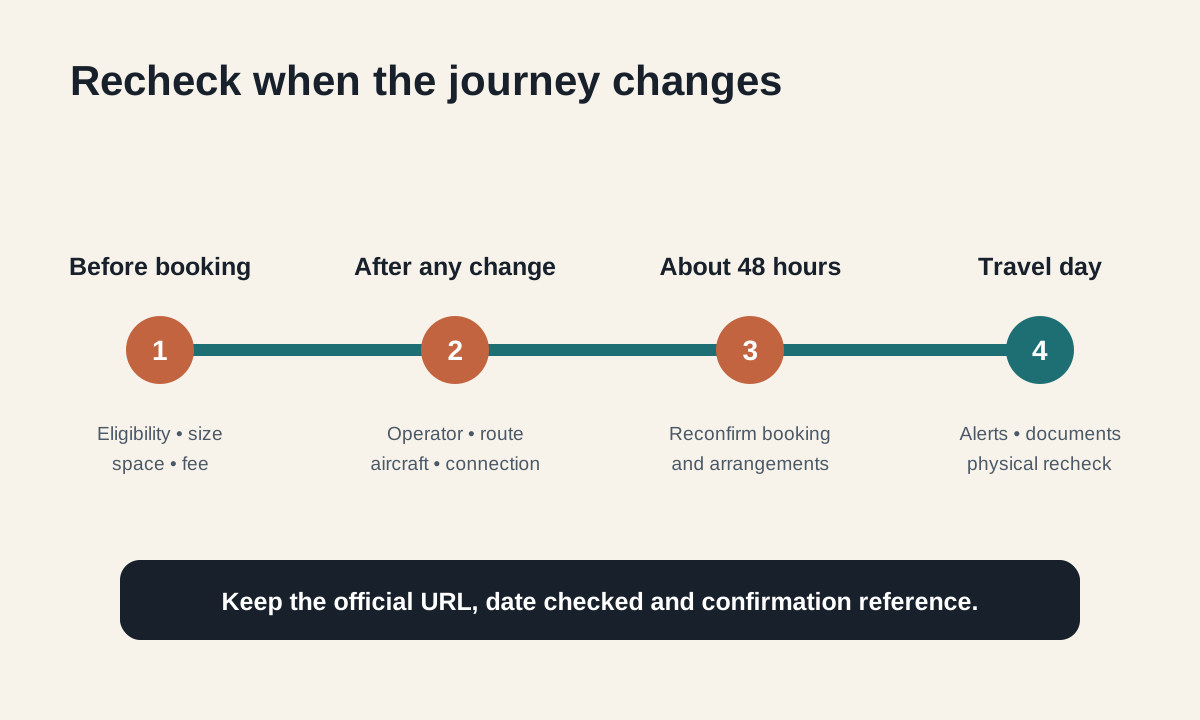
- Before booking: verify eligibility, dimensions, weight, documents, reservation availability and total fees.
- After a schedule change: check the new operating airline, route, connection and aircraft.
- About 48 hours before departure: IATA’s passenger guidance recommends reconfirming the booking and live-animal arrangements with the airline.
- On travel day: review alerts, bring the airline confirmation and required originals, and allow time for the airline’s check-in process.
Use a controlled airport sequence
- Exercise and feed only according to your veterinary and airline plan; avoid making a new routine on the day.
- Check the pet’s condition before leaving home. If the pet appears ill or distressed, contact a veterinarian and the airline.
- Secure every opening before transport and keep the carrier under direct control.
- At security or inspection, follow staff directions and ask for a private screening room if opening the carrier in a public area would create an escape risk and the facility offers that option.
- After screening, recheck every closure before moving away.
- Follow the operating airline’s stowage instructions on board; do not assume the carrier may be placed on a seat or opened.
Quick answers
Is there one standard airline pet-carrier size?
No. Limits can vary by airline, aircraft, route and carrier type. Verify every operated segment directly with the airline.
Does “IATA compliant” mean an in-cabin bag is accepted?
No universal acceptance follows from that phrase. IATA publishes guidance but does not endorse individual commercial models, and airlines may apply stricter rules.
Should I use the carrier’s internal or external measurements?
Record both. Airline stowage limits generally concern the external envelope, while animal fit depends on the usable internal space. Confirm the airline’s wording.
Can a soft carrier be larger because it compresses?
Only the airline can answer for the specific journey. Compression must not compromise required fit, ventilation or animal comfort.
What if one flight is operated by a partner airline?
Check the operating carrier for that segment and ask how the ticketing and operating policies interact. Record the answer before booking.