August 19, 2026
Cat Carrier Training: When the Door Causes Fear
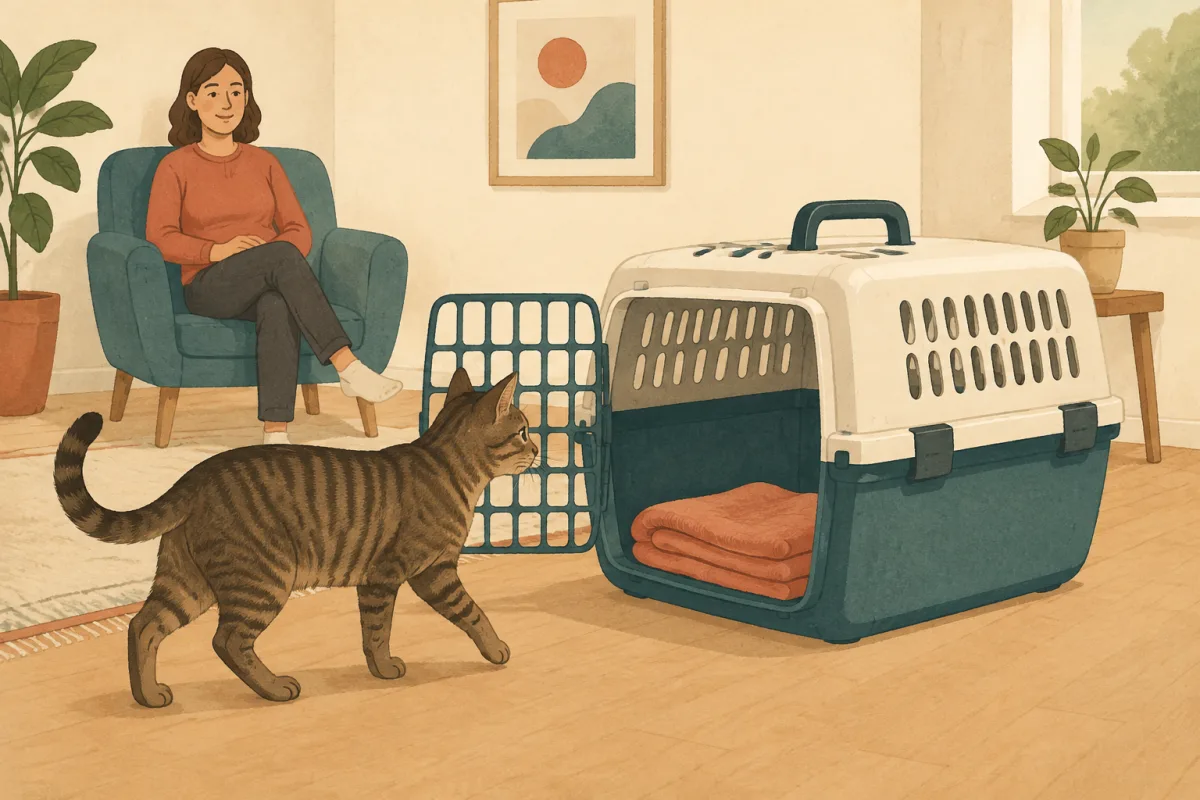
If your cat enters a carrier but becomes frightened when the door moves or closes, practise that smaller transition before adding time, lifting or travel. Leaving the carrier out is a useful starting point, but it does not show that your cat is comfortable with confinement. Cat carrier training should progress from voluntary approach to relaxed closure and supported movement, with room to return to an easier step.
This guide is for planned practice with a cat who is otherwise well. It is not an emergency loading technique, a medication plan or proof that a carrier suits your cat. If a visit cannot wait, contact your veterinary practice for a handling and transport plan. Do not postpone needed care until training is complete.
The header is an AI-generated explanatory illustration of a generic carrier setup, not a CarryDen product photograph or a documented training result. The diagrams below are planning aids, not clinical scoring tools.
Check the carrier and setting
Start by checking usable space, a stable base, ventilation, closures and access. A cat who cannot rest or reposition comfortably has an equipment problem that training cannot solve. Use the carrier measurement worksheet and the carrier format comparison before deciding to keep practising with the same container.
FelineVMA’s Cat Friendly Homes carrier guidance discusses sturdy construction, accessible openings and removable tops. These features can make familiarisation and examination easier to arrange. They are not certification of a specific product. A backpack, sling or soft bag is not interchangeable with a roomy handheld carrier merely because the stated weight limit fits.
Put the carrier on a secure floor in a quiet room, with the entrance held safely open and a clear route away. Use familiar, clean bedding that does not obstruct ventilation. Keep exterior doors and windows closed during practice. Avoid starting in the hallway just as people are leaving: carrier appearance, keys, rushing and a closing door would all arrive together.
Cats Protection’s carrier-training guide starts with voluntary exploration and moves closer in stages when a cat is wary. If your cat avoids the whole area, begin at a comfortable distance rather than moving rewards deeper inside to entice a frightened entry.
Cat carrier training: readiness, not a deadline
The useful question is not how many days have passed, but which part of the sequence your cat can handle without becoming fearful. International Cat Care’s veterinary-visit guide separates bedding, carrier assembly, a closed door, time inside and movement. Its stages are a progression, not a promise of completion on a calendar.
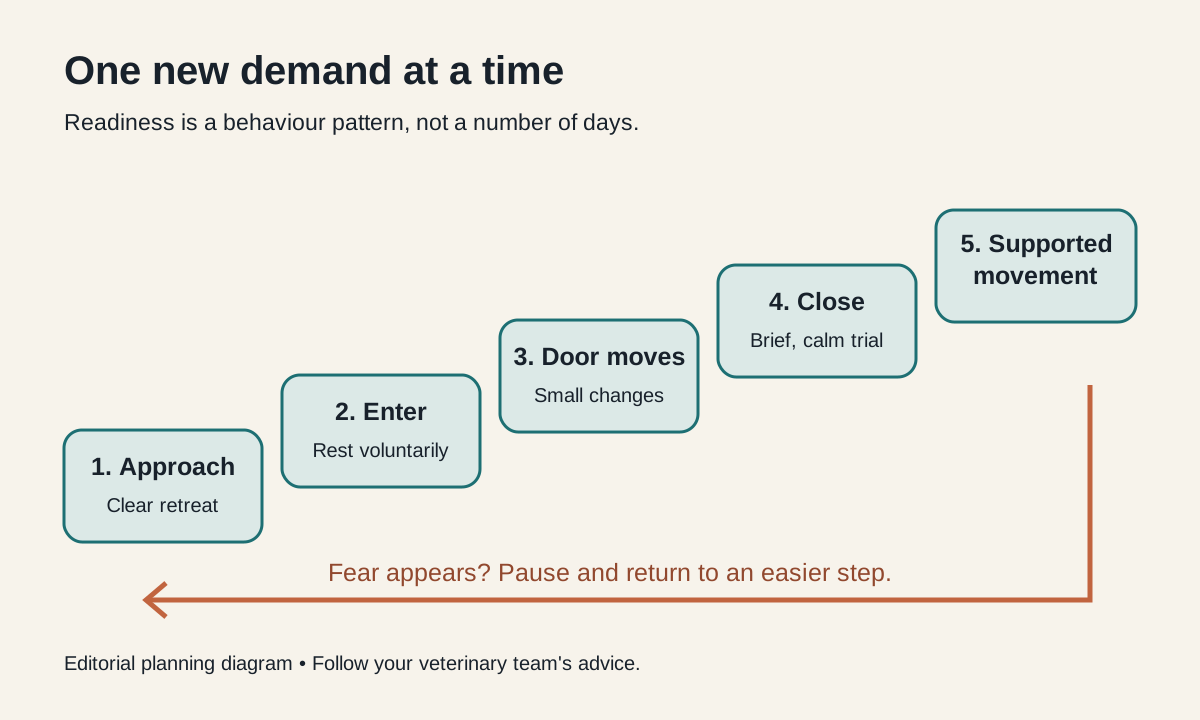
| Current step | What to observe | What not to add yet |
|---|---|---|
| Approach the open carrier | Voluntary investigation and an easy retreat | Closing the entrance behind the cat |
| Enter and rest inside | Comfortable posture while you remain nearby | A new latch sound, lifting and a timer together |
| Notice small door movement | No new fear when the door moves a little | Longer confinement |
| Brief closure | A settled cat and a calm reopening in the secure room | Leaving home immediately |
| Supported movement | Comfort with the base level and the journey still familiar | A long or busy trip as the first rehearsal |
This table is an editorial checklist for observations, not a validated test. No single posture or accepted treat proves readiness. Repeat comfortable practice across sessions and judge the whole response. If you cannot identify a relaxed starting point, ask your veterinary team for help instead of making the carrier harder to leave.
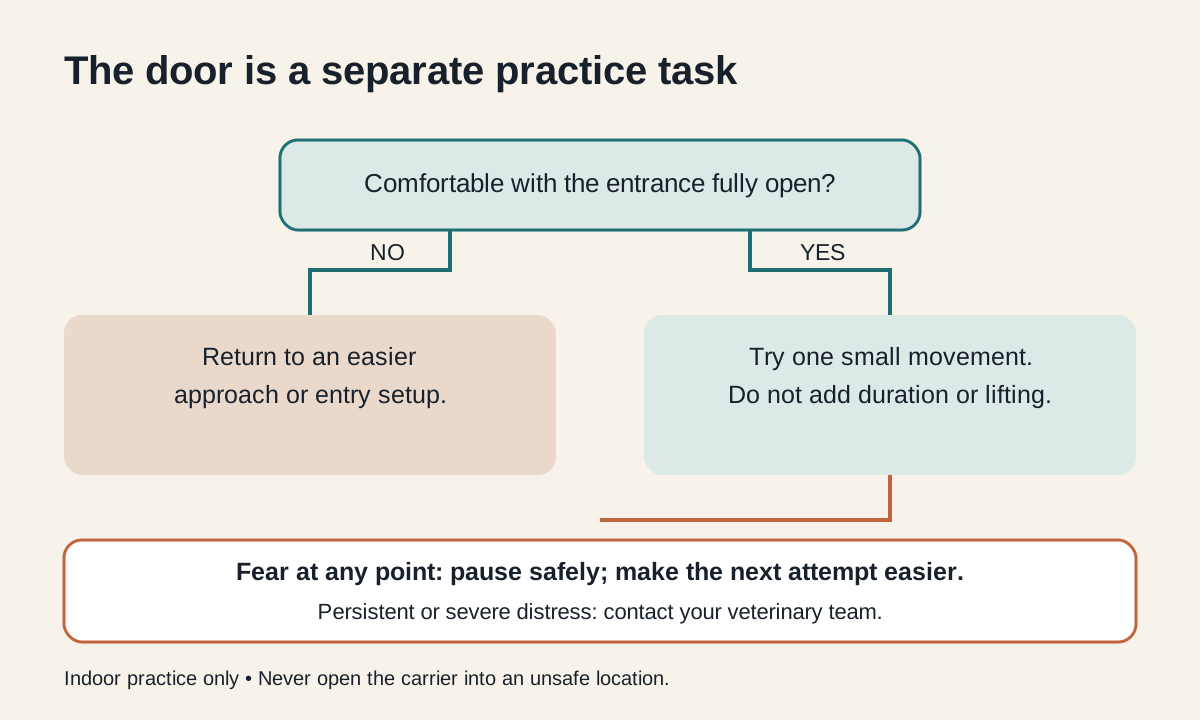
Work on the door separately
Watch for the first change: does the cat react when your hand approaches, when the door swings, when a zip sounds or only when the opening disappears? Those are different practice targets. Do not assume a cat who sleeps in an open carrier is ready for all of them together.
VCA’s explanation of desensitisation and counterconditioning describes controlled, low-intensity exposure paired with something the animal values. Applying that principle here means reducing the particular movement or sound that worries the cat, rather than repeatedly completing a frightening closure.
- Return to comfortable open-carrier practice in the secure room.
- Choose just one small change, such as bringing a hand near the door while leaving the opening clear.
- Pair calm participation with a reward the cat already likes, without blocking the exit.
- Try a little door movement only when the earlier change is comfortable. Closure, duration and carrying remain separate tasks.
- If fear appears, end the attempt safely and reduce the next session’s difficulty. Do not keep repeating the same failed closure.
FelineVMA’s positive-reinforcement guidance emphasises choosing a reward the individual cat values and delivering it promptly. Food is not the only option: appropriate play or gentle social interaction may matter more to that cat. A reward that works in the living room but is refused near the carrier is useful information to record, not a reason to force participation.
Recognise when to pause
Look for changes from your cat’s ordinary behaviour: a tense crouch, ears pressed back, hiding, attempts to flee, hissing or defensive contact. Stillness can be fear rather than relaxation. Cats Protection explains that stress signs can be subtle and can overlap with pain or illness; a shopping or training guide cannot distinguish these reliably.
In a secure indoor practice room, stop adding demands and restore an easier setup when safe. Do not open a carrier beside traffic or an unsecured exterior door to end a difficult attempt. If handling the cat or opening the carrier risks injury or escape, get professional guidance rather than reaching in to restrain a struggling animal.
Never punish, shake the carrier or wait for a panicking cat to give up. FelineVMA advises against punishment and recommends veterinary contact for concerning behaviour changes. New pain, breathing difficulty, collapse, injury or marked deterioration needs urgent veterinary advice, not another training session.
Add supported movement later
Introduce lifting only after comfortable closure. Support the base as well as the handle, keep the carrier level and begin in the familiar indoor setting. International Cat Care specifically cautions against carrying by the handle without stabilising the bottom. The cat should not slide as the container tilts or swings.
Separate the next layers: being lifted, crossing a room, approaching a stationary vehicle and eventually a short trip under an appropriate transport plan. Do not use a successful indoor lift as evidence that motorway noise or airport queues will be comfortable. Carrying readiness, fit, vehicle restraint and airline acceptance are different checks.
Our flight-specific carrier checklist covers travel-rule verification. For vehicle positioning and restraint, follow current guidance for the actual carrier and car; this article does not provide universal seatbelt routing or claim crash certification. Never leave the cat unattended in a vehicle.
Keep a useful practice record
A short record helps you separate progress from simply spending more time near the carrier. The following is a planning template, not a report of cats tested by CarryDen. Record observations without labelling the cat stubborn or declaring a session successful only because escape did not occur.
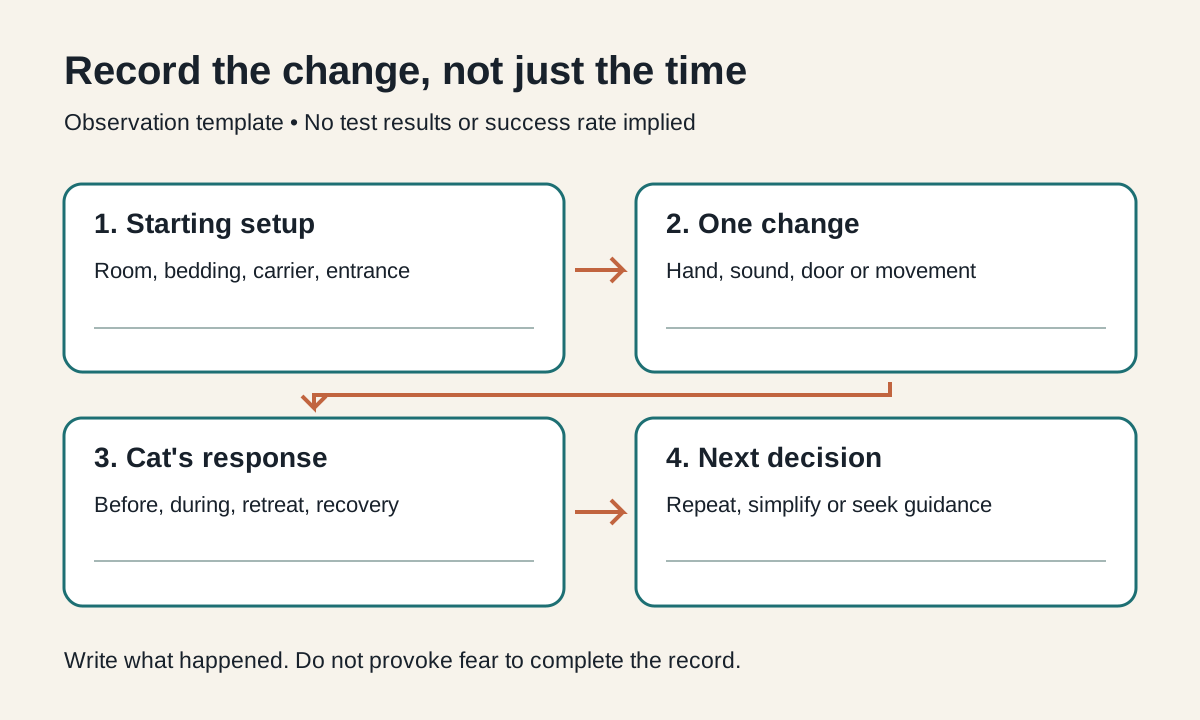
| Record | Illustrative entry, not a test result |
|---|---|
| Starting setup | Same room and bedding; entrance fully open; no travel preparations |
| One intended change | Move a hand toward the door; do not close or lift |
| Observed response | Write what the cat did before and after the change, including retreat and recovery |
| Next decision | Repeat the comfortable step, reduce the change or seek guidance |
Also note date, approximate duration, reward offered, unusual sounds, health changes and what happened after practice. A brief video may help your veterinary team if you can record without increasing stress. Do not provoke fear to obtain footage. Bring the record and the exact carrier details to the discussion; a generic statement that the cat hates carriers gives the clinician less to work with.
When the appointment is soon
Training and an immediate transport need are different jobs. Call the practice early and explain what happens at approach, entry, closure and movement. Ask about suitable access openings, a handling demonstration, arrival arrangements and whether a clinician needs to assess pain, nausea or fear. Tell them about existing medical conditions and prescribed treatment.
Cat Friendly Homes recommends avoiding a chase and consulting the veterinarian when practice has not resolved carrier distress. Medication decisions belong to that veterinarian. Do not copy a Reddit drug, dose or combination, and do not change food or medication instructions without checking the individual care plan.
A calendar reminder is a prompt to contact the clinic, not a deadline your cat must meet. If care is urgent, follow veterinary or emergency-service directions now. Once the immediate need is over, resume planned practice at a comfortable starting point instead of assuming the journey itself completed the training.
Quick answers
Why does my cat enter happily but panic when I close the door?
Entering, door movement, latch noise and confinement are separate experiences. Identify the first change that triggers fear and return to a comfortable earlier step. Persistent or severe distress needs veterinary or qualified behaviour guidance.
How long does cat carrier training take?
There is no completion time promised here. Progress by comfortable behaviour across sessions, not by a fixed number of days. Contact the clinic early if an appointment is approaching.
Should I leave the carrier out all the time?
Keeping a suitable carrier available with familiar bedding can support voluntary exploration. It does not replace gradual practice with the door or solve poor fit. Keep the entrance safe and the carrier clean.
Should I keep the door closed until my cat stops struggling?
No. This plan does not use prolonged fear or exhaustion as training. Manage the situation safely, seek help when needed, and make future practice easier; never release the cat into an unsafe location.
Do I need to buy a new carrier?
Not automatically. Check space, stability, access and condition first, then discuss persistent avoidance with the veterinary team. A new purchase does not guarantee acceptance, and this guide does not recommend a particular product as a treatment.
Sources and scope
Prepared by the CarryDen Editorial Team from the linked FelineVMA, International Cat Care, Cats Protection and VCA educational materials, checked September 5, 2026. CarryDen has not conducted a clinical training study or obtained a veterinary review of this article. The observation worksheet is our editorial synthesis, not a clinical protocol. Follow your veterinary team’s advice for your cat.
A Reddit owner’s question about distress despite leaving a carrier out helped identify the content gap. The discussion is a question source only; its medication and handling suggestions are not the basis of this guide. For equipment decisions, return to the measurement worksheet rather than treating calm behaviour as proof of fit.